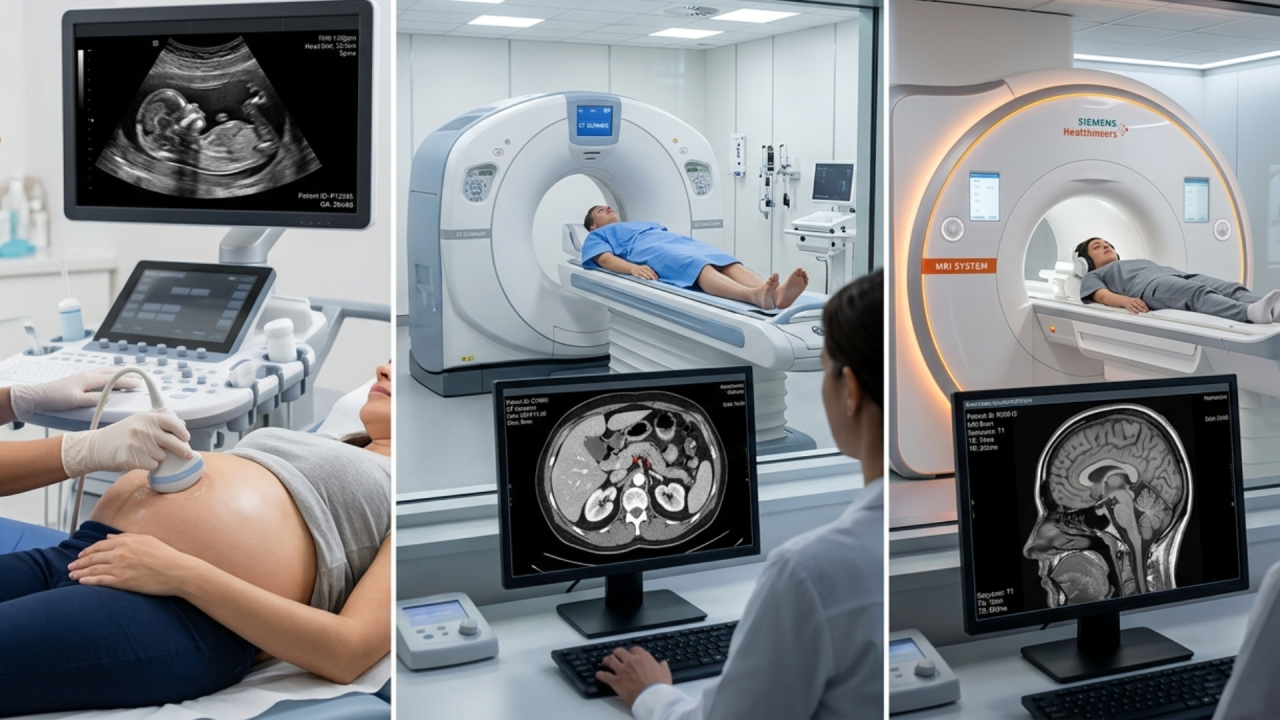
Diagnostic medicine has advanced remarkably in recent decades, allowing physicians to observe the inside of the human body with previously unimaginable precision. Among the most widely used tools are ultrasound, computed tomography (CT) scans, and magnetic resonance imaging (MRI).
These three imaging techniques are fundamental for diagnosis, disease monitoring and treatment planning, but each has specific characteristics, indications and benefits.
At Clínica Hospital San Fernando, we have specialized radiology and medical imaging services, which allow us to perform these studies with advanced technology and highly qualified personnel.
🩻 1. Ultrasound: the first line of defense against the invisible
Ultrasound, also known as sonography, is a study that uses high-frequency sound waves to create real-time images of internal organs and structures.
📌 How does it work?
A transducer emits waves that bounce off tissues and return as echoes, which are interpreted by specialized software, creating a real-time visual image. This allows observation of everything from soft tissues to moving organs.
📌 When is it used?
Ultrasound is especially useful for:
• Evaluate abdominal organs such as liver, kidneys, pancreas, and gallbladder.
• Gynecological and obstetric studies, such as pregnancy monitoring.
• Detection of masses or cysts.
• Bladder and prostate assessment, among others.
📌 Advantages of ultrasound
• It does not use radiation.
• It is safe, fast and non-invasive.
• Enables real-time observations.
At Clínica Hospital San Fernando, the ultrasound service is available to patients with a doctor's order, integrated with the laboratory and specialized care in gynecology, internal medicine, urology and more.
2. Computed tomography (CT): accuracy in cross-sections
Computed tomography is a technique that uses X-rays and advanced computer processing to produce detailed cross-sectional images of the body, allowing clear views of tissue, bone, and organ sections.
📌 How does it work?
The device rotates around the patient to collect multiple images from different angles, which are then digitally reconstructed to create a three-dimensional view of the area of interest.
📌 When is it used?
CT scans are especially valuable for:
• Evaluate complex trauma.
• Detect internal bleeding.
• Visualize bone structures in detail.
• Plan surgical approaches.
📌 Advantages of tomography
• High image resolution.
• Detects lesions that may not be visible on conventional x-rays.
• Useful in emergency or trauma situations.
At Clínica Hospital San Fernando, tomography is available as part of the radiology service for patients with a medical indication, integrating with emergency consultations, internal medicine, traumatology and surgery when appropriate.
🧲 3. Magnetic resonance imaging (MRI): detailed images without radiation
Magnetic resonance imaging (MRI) uses magnetic fields and radio waves to generate highly detailed images of soft tissues, without using ionizing radiation.
📌 How does it work?
Using powerful magnets and radiofrequency pulses, the MRI detects the body's proton response, allowing for the generation of high-resolution images of the brain, spine, joints, and soft tissues.
📌 When is it used?
MRI is ideal for:
• Complex neurological assessments.
• Diagnosis of muscle and joint injuries.
• Exploration of internal organs in great detail.
• Spinal cord problems.
📌 Advantages of MRI
• High resolution for soft tissues.
• No radiation.
• Very useful in complex diagnoses and treatment monitoring.
At the San Fernando Hospital Clinic, MRI scans are performed using appropriate protocols according to the patient's needs and always under specialized medical supervision.
🧠 Which test should be requested?
The choice between ultrasound, CT scan, and MRI depends on the doctor's clinical evaluation.
treating physician and the patient's symptoms or suspected diagnoses. Each technique provides information
valuable and specific, so they often complement each other for a more comprehensive assessment
complete.
🏥 Comprehensive hospital services that support imaging studies
At Clínica Hospital San Fernando, diagnostic imaging studies do not function in isolation, but as part of an integrated care system that accompanies the patient at every stage:
• Medical consultations with specialists who order and analyze the studies.
• Clinical laboratory that complements diagnostic information.
• Primary care and internal medicine for continuous follow-up.
• Operating rooms and image-guided procedures when intervention is required.
• 24/7 Emergency Department with rapid access to imaging studies in critical cases.
By combining diagnostic technology, imaging specialists, and a comprehensive clinical approach, the hospital ensures safe and reliable assessments.
🧩 Conclusion: every picture counts
Ultrasound, tomography, and MRI are not exclusive tools of medical technology: they are indispensable allies for accurately detecting, diagnosing, and monitoring health conditions.
Whether for preventative monitoring, disease tracking, or evaluation of specific symptoms, these studies allow doctors to make informed decisions and plan effective treatments.
At Clínica Hospital San Fernando, you will have access to these services with the guidance of professionals who prioritize your well-being.